 Credit Cards
Is Your 'No Cost' EMI Really Free? A Guide to GST Rates and Credit Card Fees
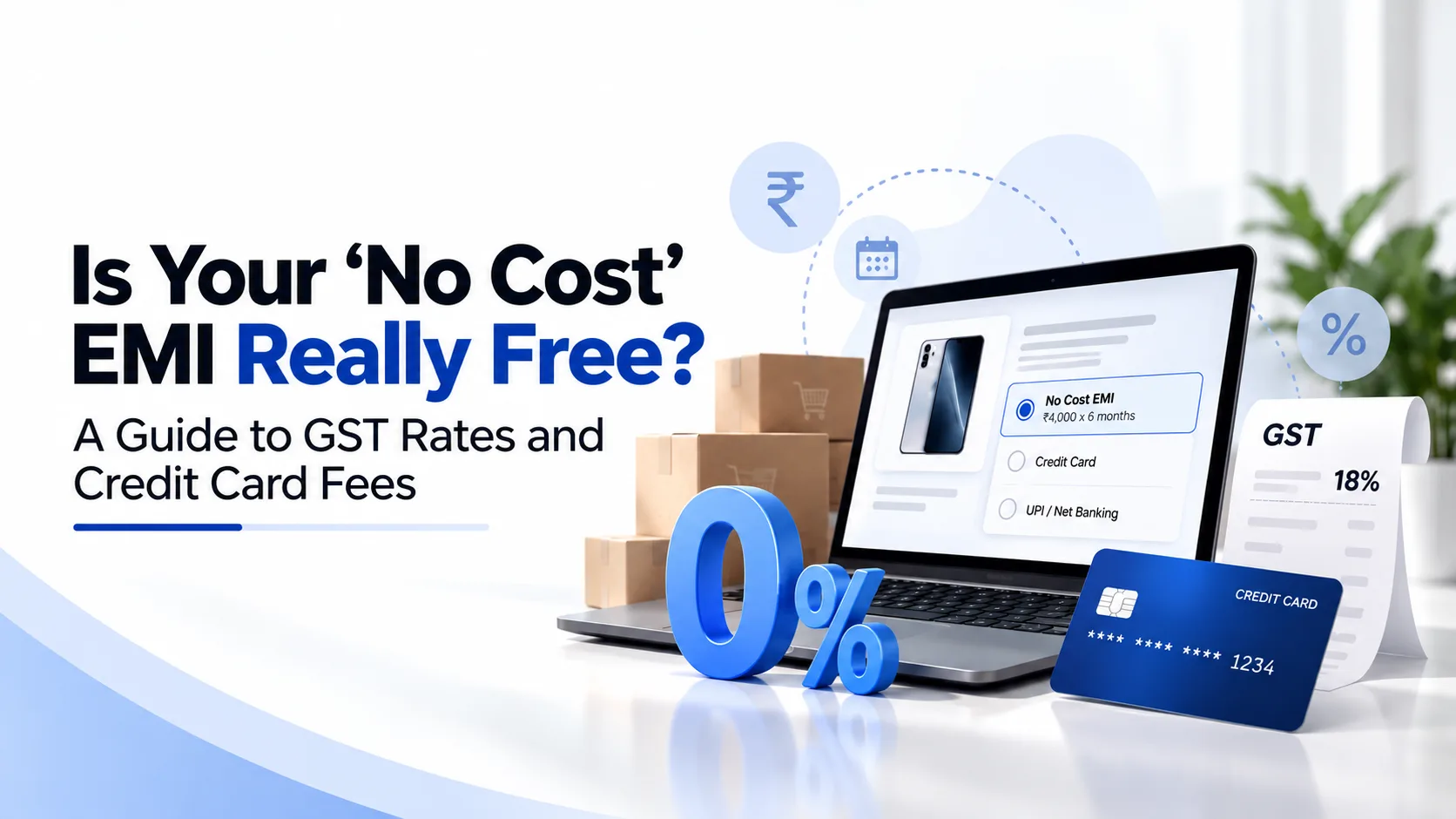
If you have ever shopped online, you may have surely come across the ‘no cost EMI’ payment option at the checkout. It may sound like the best payment option as it allows you to break the payment into smaller instalments and pay the amount over a period, instead of paying the full amount at once. But, as a smart and savvy online buyer, you need to ask is the ‘no cost EMI’ really free or does it have any hidden charges? Well, in most cases, the answer is there are certain charges that are applicable on the no cost EMI that you may not be aware of, like the GST (Goods and Service Tax) charges. So, in this blog, we break down how the GST works on ‘No Cost EMI’ and how much you really pay. Understanding What is No Cost EMI and Its Working? Before we delve into the finer details of the costs associated with ‘No Cost EMI,’ let us understand what exactly the term means. In simple words, ‘No Cost EMI’ means you can buy something today, and pay the amount in small parts over a period, without paying anything extra. The price of the product remains the same and there is no added interest cost like in regular EMIs. Let us understand its working with an example. Mr. Arjun Mehra purchases a new smartphone at Rs. 24,000 from an e-commerce platform. Now, he does not have the full amount to pay at once. So, he chooses the EMI option of six months at the payout. He now has to pay only Rs. 4,000 every month. Mr. Mehra does not have to pay any additional money; the price of the phone remains the same. Usually, in a regular EMI, you would have to pay an interest. So, the total cost becomes more than the actual product price. Whereas, in No Cost EMI, the interest is not charged from you directly, however, the seller adjusts it in the backend. Here how they do it: · The seller typically offers a discount equal to the interest that would have been charged. · The discount is used to cover the interest cost paid to the financial institution. · So, you pay for the product in parts, and it looks like you are paying no interest. Since you are paying the amount in smaller instalments, it feels like a convenient option. But the reality is the No Cost EMI is not always truly free. Charges like GST are still applied. Is GST levied on No Cost EMI? Yes. GST is applied on all No Cost EMIs, but not in the way you may think. While the name No Cost EMI suggests that there is no additional cost involved, if you take a closer look at the payment structure, you will understand the actual reality. In a no cost EMI payment scheme, the financial institution still charges interest on the transaction. However, the seller gives you a discount that covers this interest. So, the total amount may seem like the actual product price. But here is the key difference. Even though the seller absorbs the interest, the amount is not exempt from GST. And according to the current GST rules, an 18% tax is applied on the interest component of the EMI. This means the financial institution charges GST on the interest, and this cost is ultimately borne by the customer. This is why you may often see a small additional amount in your credit bill despite opting for a ‘No Cost EMI’ plan. Breakdown of GST Charges on No Cost EMI Plans Let us assume that you purchase a smartphone worth Rs. 30,000 and you choose a 3-month No Cost EMI payment option. This means you would have to pay Rs. 10,000/month with no additional cost. But if you look at your credit card bill closely, here is what happens behind the scenes: The financial institution charges an interest of Rs. 734.66 over three months The seller gives you discount equal to the interest amount But GST is charged at 18%, i.e., Rs. 132.24 is applied to the bill and it is not waived off You pay this GST, and not the seller In a nutshell, the No Cost EMI is not fully free, it involves GST charges and you have to pay it.